
Over the past 6 years, we’ve photographed thousands of UK properties. From modest terraces in Manchester to Lakeside estates in the Lake District, from first-time buyer flats to multi-million-pound Hale conversions. The value adds up to over £1 billion in listed property.
That volume brings perspective. When you’ve shot 50 kitchens in a week, patterns emerge. You start seeing what works and what doesn’t. Not theories from marketing textbooks. Instead, real data from real listings competing in real markets.
We’ve been lucky. Most agents see their own listings. Most photographers work solo. We’ve had a rare view across thousands of properties, dozens of agencies, and every price bracket. Here’s what that taught us.

Consistency Beats Perfection
Every photographer dreams of golden hour light. That magical time when warm sunlight floods through windows and makes every room glow. Here’s reality: most viewings happen at lunchtime on weekdays. Most vendors work full-time. Most properties go live under grey British skies.
We learned to embrace overcast light. It’s predictable. It’s consistent across rooms. It doesn’t create harsh shadows or blown-out windows. Buyers aren’t comparing your listing to a sunset magazine shoot. Instead, they’re comparing it to the house next door that was also photographed on a Tuesday afternoon.
The properties that sell aren’t the ones with perfect light. They’re the ones that respect vendor schedules, launch quickly, and present homes honestly. Instagram fantasies don’t pay mortgages. Reliable, professional imagery does.
We have many methods to brighten up these kind of shots, like adding blue skies etc.

First Impressions Control Buyer Behaviour
Your hero image gets three seconds on Rightmove. Maybe four if you’re lucky. In that moment, buyers make instant decisions. Scroll past or click through. It’s brutal, but it’s measurable. Listings with strong opening images generate viewing requests within hours. Weak openers sit for weeks.
We’ve seen identical houses in the same street perform completely differently based purely on that first shot. Same layout, same price, same agent. Different response rates. The psychology is simple. Buyers scroll portals like social media that are fast, ruthless, emotion-led. Your hero image isn’t information delivery. It’s a promise. A feeling. An invitation to imagine their life in that space.
Get that wrong, and your carefully written description never gets read. Your floor plan never gets viewed. Your video tour sits unwatched. Everything downstream depends on that opening moment.

Presentation Changes Perceived Value
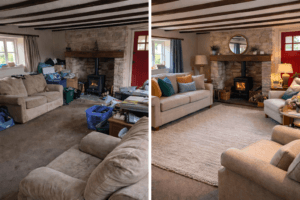
We once photographed two identical new builds on the same development. Same builder, same layout, same finishes. One was empty. One had basic staging like sofa, rug, and a couple of cushions. The staged property received double the viewing requests and sold for £15,000 more.
Same bricks. Same rooms. Different emotional response. Staging isn’t about luxury. It’s about helping buyers imagine themselves in the space. An empty room forces them to do mental work. A presented room does that work for them. It answers the question: “Could I live here?”
This applies beyond staging. Decluttered surfaces, straightened cushions, cleared kitchen counters. They don’t make your property better. They make it easier to buy. There’s a difference.
Buyers Compare Instantly
Your property isn’t competing with average listings. It’s competing with the best listing in your price bracket within your area. A buyer searches “3-bed semi Leeds £250k-£280k” and sees twenty results. Yours needs to stand among the top five visually, or it becomes invisible. Price alone doesn’t win anymore.
We see this clearly in tight markets. A well-presented £270k home will generate more interest than a poorly presented £265k equivalent. Why? Because buyers judge quality before price. They shortlist emotionally, then justify logically.
This isn’t theory. Track portal analytics. The listings with professional imagery receive more saves, more shares, more viewing requests. You can do this even when they’re not the cheapest option. Buyers benchmark visually first. Everything else comes after.

Trust Is Everything Online
Oversaturated skies. Wildly bright interiors. Impossibly vivid colours. We’ve all seen them. In other words, property photos that look more like video game renders than real homes.
Here’s the problem: buyers aren’t stupid. They spot manipulation instantly. And when they spot it, they lose trust. If you’re lying about the colours, what else are you lying about?
Modern buyers are sophisticated. They’ve seen thousands of property listings. They know editing tricks. Heavy-handed enhancement doesn’t make properties look better. However, it makes them look suspicious.
We’ve tested this repeatedly. Natural, honest photography generates more serious enquiries than hyper-edited alternatives. Buyers want confidence, not creativity. They want to know what they’ll actually see when they arrive for a viewing. Authentic imagery builds trust. Trust generates viewings. Viewings create sales. It’s that simple.

Marketing Is Now Part Of The Product
Twenty years ago, marketing supported property sales. Agents found buyers. Marketing just helped communicate. That’s reversed. Today, marketing doesn’t support the sale, but it IS the sale.
Buyers start online. They filter, compare, and shortlist entirely through digital content before any human conversation happens. Your photography, your floor plan, and your description. These aren’t just supporting materials. They’re the first showing. Often the only showing.
Properties with poor marketing don’t just sell slower. They sell for less. Buyers assume presentation quality reflects property quality. Weak imagery signals motivated sellers, hidden issues, or lack of care. None of those perceptions help negotiation.
Strong marketing creates competition. Competition creates urgency. Urgency protects price. The photography isn’t decoration, but it’s commercial strategy.
The Big Pattern
After £1 billion of property and thousands of listings, one pattern towers above everything else. Homes that create emotional connection generate viewings. Homes that only present information get ignored.
Buyers don’t choose houses logically. They choose emotionally, then build logical justification afterward. Your job and our job is to trigger that emotional response in three seconds on a portal screen.
The properties that achieve this aren’t always the biggest or best. They’re the ones that make buyers feel something. That feeling starts with a photograph. Everything else follows from there.